Hats of winter

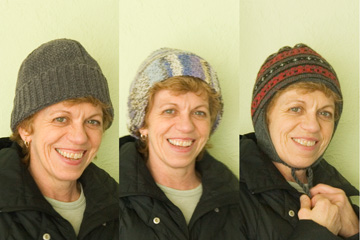
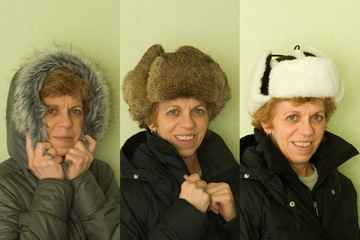
This is now my fourth winter in Minnesota.  When I moved here, I owned one hat – a baseball hat used to keep the rain off my face in Washington.  I didn’t really like hats.  But I quickly learned there is a whole culture of hats in Minnesota!  People love their hats,  and there are so many different styles of hats to love.  There are lightweight hats for early winter, there are hats that are meant to keep the top of your head warm, there are hats to tie under your chin to keep your cheeks and neck warm, and there are hats or hoods that are connected to your coat.   And then as winter progresses and the temps get colder and colder, there are hats that keep every part of your head, ears, and upper body warm — these are the ones with flaps that come down and around, and are your very best friend on a sub-zero day.  These are just some of my current hat collection (ok, one of them is borrowed but it’s so cool I just had to model it too!).    The other cool thing about Minnesotans is they don’t care if you have hat-hair or not.  Hat-hair is what everyone has, it’s a fact of life, and it’s just the way things are when the temps are hovering around zero.  Practicality wins out over the fashionistas when survival is at stake.  Winter hats are just one of the things I like about Minnesota.
Book Across the Bay, 2010 edition

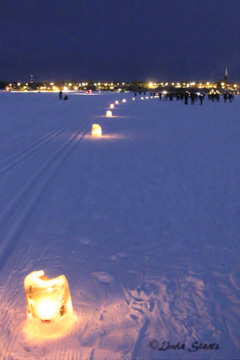
We’ve just returned from a delightful weekend in Ashland, Wisconsin on the shores of Lake Superior.  With a dear friend from Seattle who wanted to experience the fun of a snow-filled winter event, our visit coincided with the 14th annual Book Across the Bay.  To celebrate the uniqueness of our upper-midwest winters (and just because we can!) over 3,300 people donned their skis and snowshoes and crossed frozen Chequamegon Bay from Ashland to Washburn, Wisconsin.  The distance of 10 kilometers was lit by frozen luminaries, and included warm bonfires on the ice marking each kilometer.  After snowshoeing for a bit more than a kilometer, I looked back to photograph this winding curve of luminaries leading to the lights of Ashland.  Although the event started under partly cloudy skies at dusk, the clouds cleared  as we worked our way across the bay, ending under a bright partial moon and a canopy of stars.  The promise of a big party, great friends, and good beer at the finish-line was our incentive to “book” the distance.

Hoarfrost in the morning

Just when I think I’ve gotten tired of the cold and the snow, Mother Nature puts a new spin on winter.  Yesterday morning I woke up to a beautiful scene.  The fog that had crept in during the overnight was freezing and coating everything with a wondrous layer of white.  Within a mile from the house I found these lovely flower heads that had been leftover from summer.  On any other day I would have walked right past them.  But with a frosting of frozen fog and their delicate arching, I became mesmerized and photographed for over a half-hour.  It was as if each small snowflake was layered ever so gently, one on top of another.   And yet this was all short-lived, as within a matter of hours the sun broke through the clouds and the wind picked up, eliminating any remnants of this morning scene.

Spring color in bloom

It’s winter outside — the ground is covered in white, the temperature is in the teens.  But this morning I walked into a breath of spring when I visited the McNeely Conservatory in Como Park.  The Winter Flower Show is now on display in the Sunken Garden, and it’s colors and sights are a treat to the eyes as much as its smells and scents are wonderful to experience.  The pinks of the azaleas and the pale whites and yellows of the pansies were a beautiful combination of color — soft and delicate as only spring can be.  In order to create a “softer” feel to this photograph, I placed a piece of plastic wrap over my lens.  It had a wonderful effect of softening the lines and making the image more about the colors and the “feel” of the colors than of the lines of the flowers.  As we deal with the snow storm that’s moving through over the next three days, I’ll easily return to my photos and my memories of the smells and colors of the conservatory garden.

Trumpeter swans on the Mississippi

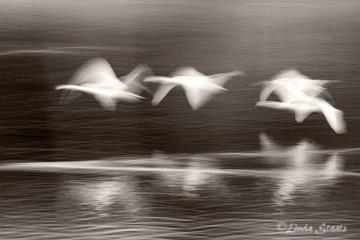
During the winter months in Minnesota many of our rivers and lakes freeze.  But there is a section of the Mississippi River that runs through the city of Monticello where the waters remain open because of a nuclear generating plant that operates upstream.  From mid-November through February, this area is home to over 1,500 trumpeter swans.  Because the swans weigh between 20-35 pounds each they need a large area to take off and land.  During a recent visit to Monticello, I spent a wonderful few hours along an open stretch of the river observing and photographing the swans as they came and went.   Not only was this a visual treat, but an auditory one as well.  The swans’ wings make a distinctive sound as they’re preparing to take off in flight.  This sound, along with their honking and the sounds of the Canada geese and ducks that were also in the area made for a wonderful cacophony that filled the cold morning air.  This is not your documentary photograph, but I chose a slow shutter speed to better convey the flight of the swans;  their grace and beauty was reflected in the river below them as they flew past me and upstream.