A trip to Kansas

I’ve recently returned from a trip to Kansas for a lovely family wedding. Two (pandemic) years have passed since I’ve seen my relatives and it was well worth the drive. En route to the wedding, and on the return to Minnesota, I carved out some time for exploring and visiting some of my favorite areas.

Near the center of the state, running from north to south, are the Flint Hills of Kansas. This is the largest expanse of tallgrass prairie that remains in the world. Most of this area has a very shallow soil with a subsurface of limestone, all of which made the area uncondusive to agriculture and spared it from being plowed. It is a landscape of big vistas, rolling hills, and grasses.

The Lower Fox Creek Schoolhouse sits on a hill within the Tallgrass Prairie National Preserve near Strong City, Kansas. Built of native limestone in 1882, classes were held in the single room from 1884 to 1930. Before arriving at the schoolhouse I had been following an old stone fence line and photographing a white church that glowed in the sunlight under a blue sky, all the time being serenaded by a herd of cows. Within twenty minutes the sun disappeared behind gunmetal gray clouds and the temperature starting dropping. When I arrived at the schoolhouse the flag clearly displayed the howling of the westerly wind. The setting took on a bleakness that I hadn’t experienced before, yet I’m sure was familiar to the early settlers that had tried to sustain a living in this area.

Hiking into the heart of fall

The colors of fall have deepened as the month has progressed; from hints of color to a landscape flush from a painter’s splash of yellow, gold, orange, red, green, and even some pink.

Earlier this month I was hiking with another photographer friend through the woods. It was a gloriously warm autumn day and the sun had broken through the clouds an hour before. The leaves on the path were noisily crunching under our boots as we followed a winding trail past a lake and into the forest. We both stopped as we looked ahead to see a carpet of pink under the usual fall colors of yellow and orange. We learned that the mapleleaf viburnum can have this pink or rose color in the fall depending on the light exposure and the weather conditions. Neither of us recalled seeing anything like this before and we spent a good amount of time photographing and marveling at the delightful array that Mother Nature had placed before us.

The start of fall

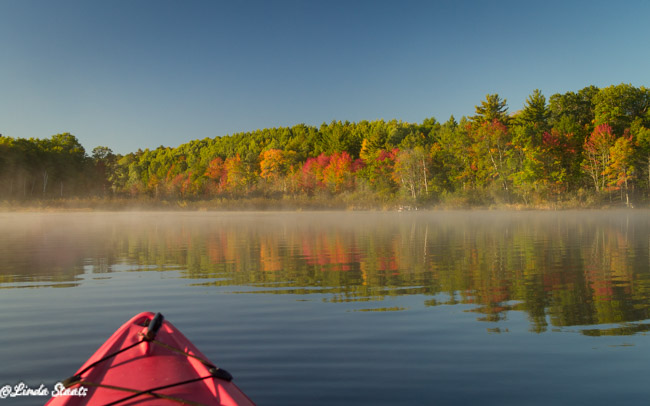
Not only has fall officially started per the calendar, but we are starting to see the change of seasons all around us. I woke up to a cool but bright morning at the lake, with steam rising up off the surface. A couple of extra layers of clothing were needed as I launched my kayak into the water. The morning was quiet except for some wood ducks that I flushed in a small bay and the Canada geese that flew past me, honking as they made their way up the shoreline. The trees have just begun to change, and the reds and golds were beautiful, especially against the blue sky and blue lake. It was a perfect start to my day, and to the season of fall

Transition time

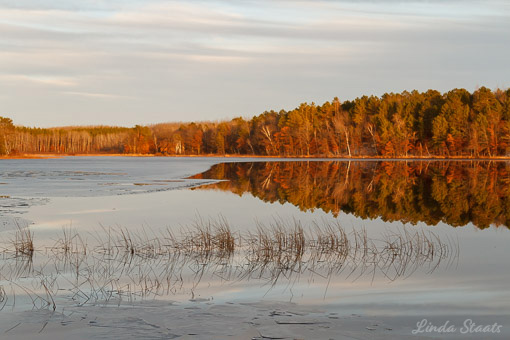
Here in Minnesota and Wisconsin we are going through our shoulder time from fall to winter. It’s a time that varies from year to year and also varies in its length. We had snow and cold in mid-October and then an unusual warm stretch in early November, causing the lake ice to begin to freeze, then thaw, and now freeze again. It’s a lovely time to observe the transition with open water and lake ice all at the same time.

With a warm glow the late afternoon sun lit up the opposite shoreline and allowed the trees to be reflected in the open water. The ice had been pushed to the north end of the lake by the strong winds that had blown the previous day. But this for moment, stillness and light came together.

Mergansers migrating through

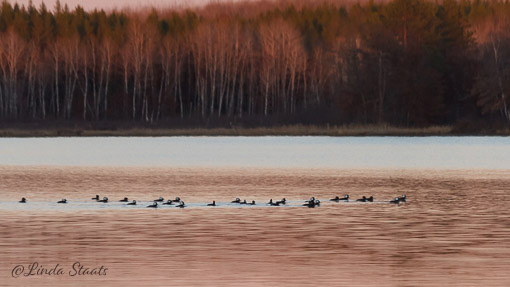
Although the lake had some ice forming a few weeks ago, the unseasonably warm stretch with temps in the 60s and 70s has kept the lake open.  And with that there’s been a steady “parade” of waterfowl on the lake.  The grebes, or helldivers, have been plentiful and there has even been a passing pair of loons.  The Canada geese are honking loudly as they fly past and then skid on the lake surface to land; their flocks seem to be getting larger as they’re preparing to migrate south in their signature V formation.

And there have been an unusually large number of hooded mergansers swimming in the lake.  I have counted up to 50 in one area, taking their turns at diving down for small fish and other food.  This evening as the sun was setting, the pink color of the sky reflected onto the lake surface as the last gasp of sunlight hit the distant shore.  Soon our lakes will freeze over and all the waterfowl will have left the northern areas and gone south in search of open water.