Edges

These have been a difficult and tough few weeks in Minnesota and Wisconsin. People are on edge. Some are hiding in fear and some are stepping out and forward. For the 20 years I have lived in Minnesota, I’ve found the people to be welcoming and caring. They’re happy to help push you out of a snow bank, recognizing that everyone has been in that situation before. When the temperatures dip to 20 below zero, you check on your neighbor to be sure they’re warm and safe. It’s what you do for your neighbors. And that’s what Minnesotans are doing now – standing up for their neighbors.

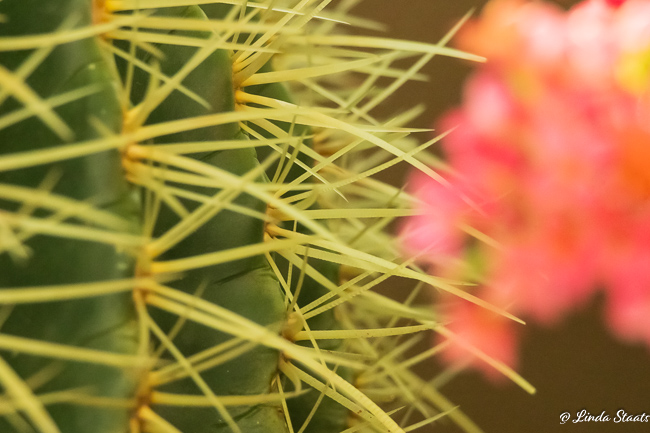
It’s been a challenge to concentrate and center my mind. One of the best ways for me to do that is to be surrounded by nature – whether it’s outside or inside with greenery and flowers. So I took myself to Como Park and spent an hour photographing at the McNeely Conservatory. The sunken garden was filled with spring flowers and colors, all of which were welcome and inviting on a cold winter’s morning. But I walked into another room at the conservatory and found three cactus in a corner. Their spikes were long and looked sharp and menacing. I immediately thought of the environment in the Twin Cities where there are menacing and sharp forces roaming the streets, schools, and businesses. And yet behind the cactus in the corner was a lovely soft kalanchoe plant covered with pink and red blossoms. As I focused my camera and framed the image, the kalanchoe colors seemed to soften the cactus and its sharp edges. Two plants side by side, both surviving in the conservatory room. Neither was better than the other. Each has its place in the environment. It all seemed to represent a difficult time where our edges are being explored and tested.

Turning into winter

Today was a morning to pull out my warm winter coat, hat, and gloves for my daily walk. With a cold start to the dawn at 18 degrees, I was treated to tiny and intricate bits of frost decorating the fallen leaves. I marveled at our passing into yet another season, and couldn’t help but think back to warmer temperatures and a now-distant summer.

At the end of August we set out on a three-week camping trip. We left northwest Wisconsin and traveled through Minnesota, South Dakota, and Wyoming – admiring the landscape changes and the beauty that’s found in every state. We drove through prairies, sunflower fields, and canyons. We enjoyed sunsets and moon rises. We camped with family while in Utah, where I was fortunate to catch my first trout!

We took in the majesty of the relatively-snow-less Teton Mountain Range and we stood in awe of the immensity of the Grand Canyon of the Yellowstone.

We journeyed back through the big-sky state of Montana and finished our trip in the badlands of the Theodore Roosevelt National Park, with the fall colors beginning to appear alongside the Little Missouri River valley.

So on these clear cold days leading further into winter, I especially enjoy the chance to revisit and appreciate the warmth and expansiveness, as well as the beauty and the variety of landscapes that we enjoyed a mere two months ago as we journeyed west.

Fall flight

In my last post I promised to share images from our camping trip to the west. But that will have to wait – fall has arrived in all its glory here in northwestern Wisconsin. The colors started to turn in early October, but we then had a week of unusually warm weather both during the day and the night. With that, the change of colors seemed to stall. And then strong and gusty winds blew all the color onto the ground.

A second phase soon developed, and our rich autumn colors have progressed to peak. It is a glorious time to be out and about. Every road and every field is alight with color. The golds and yellows, reds and oranges, and the deep russet of the oaks – they are all appearing in a symphony of color right now.

With this there is a great migration of birds coming through and starting their journey south. The loons were gone by the first few days of October. The males left first and were followed later by the females, leaving the young ones to fend for themselves and then to head south on their own. It’s amazing to me that these loons that were only born a few months ago can navigate their way south by themselves.

The Canada geese and the wood ducks are gathering. The sandhill cranes are feeding in the harvested fields. Soon all of these will be leaving. The last birds to come through our area seem to be the hooded mergansers. They will arrive and yet leave a short time later. And then our lakes will start to freeze.

But this is the time to know that the cycle of seasons continues once again, and we can appreciate Mother Nature’s palette of colors before we transition to winter.

Wildlife abounds

We’ve had the wonderful opportunity to observe and enjoy nature in northwest Wisconsin. Our small lake and surrounding woods have provided us with stunning sunrises over the opposite shore, menacing storms that roll in over the lake, fall colors that never last long enough, and bountiful wildlife sightings. But for the first time in seven years, we have a loon family that is carefully guarding its new chick from all predators, including the eagles and their young eaglets.

We first saw the loon chick swimming on its mother’s back. It was certainly learning about the lake and seeing the big world around it with fresh eyes. Both parents were nearby and watching carefully. They would dive and get small fish and feed them to the chick – a pretty easy life when you’re young.

And then in a seemingly few days, the chick was old enough (and big enough) to be swimming on its own. We watched the parents dive down into the lake, and eventually the chick learned how to do it also. It was not as dependent on its parents for food, but it was still small enough that it needed the watchful eyes of its parents for safety.

At the far end of the lake is the eagle’s nest, high in the top of a tree. We’ve watched the eagles fly over the lake and swiftly swoop down to catch fish in their large talons and carry back to the nest to feed their eaglets.

We’re looking forward to seeing the young grow and mature. They have many adventures and so very much to learn before winter comes when the loons will migrate south and the eagles will claim their territories.