Autumn and other transitions

We have officially transitioned to fall with the autumnal equinox today. Our daylight hours become shorter and the darkness of night becomes longer. There’s a change in the air, and here in the North the sun is losing its intensity and its heat. The green leaves aren’t the same deep shade of green, and in many places the yellows, oranges, and reds are starting to dot our landscape.

I have also gone through a transition these past months, as we have sold our house in Minnesota and have moved to our cabin in northwest Wisconsin. Just as the days become shorter gradually, it became clear to us, gradually, that this move was in our best interests. And yet it’s hard to pack up and move from a house, a neighborhood, a community that you’ve been a part of for 20 years.

After the move we headed out on a 3-week camping trip – a chance to escape from packing and unpacking, loading and unloading. We took our 16-foot Scamp travel trailer and headed west through the Dakotas, Wyoming, Utah, and Montana. It was a grand adventure and an opportunity to explore our National Parks and forests and be in much different landscapes. I’m planning to share some of those images and stories in the future. The image in this post was from a week ago on a prairie in northwest Minnesota near the Red River Valley where the goldenrod was already in its fall display of yellow.

If you’re looking for a way to celebrate the autumnal equinox, I would suggest spending some time in nature – get out for a walk, breathe in the autumn air and notice the difference from even a month ago, and enjoy a sunset. Nature has a wonderful way of helping us through transitions as it is always cycling from one season to the next, from one sunrise to sunset to sunrise again.
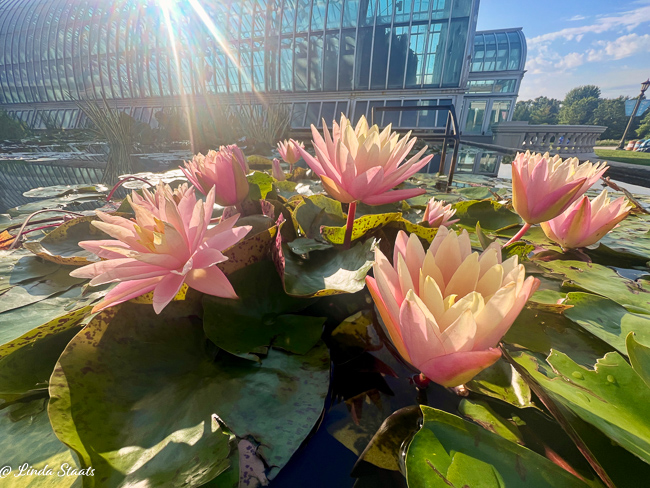
Summertime!

We are in the middle of summer. Warm temps, sunshine, and those carefree days to be spent outside. As we get older we forget how precious the summer days are. The bright sunlight is something to soak up, and the summer-worthy adventures are waiting out the door.

The recent thunderstorms that developed and rolled through the area are a reminder that even the dark clouds eventually depart and the summer sun will appear yet again. To reach up and out to the sun, to embrace all its warmth and light – those are the reminders of how we’re to enjoy summer.

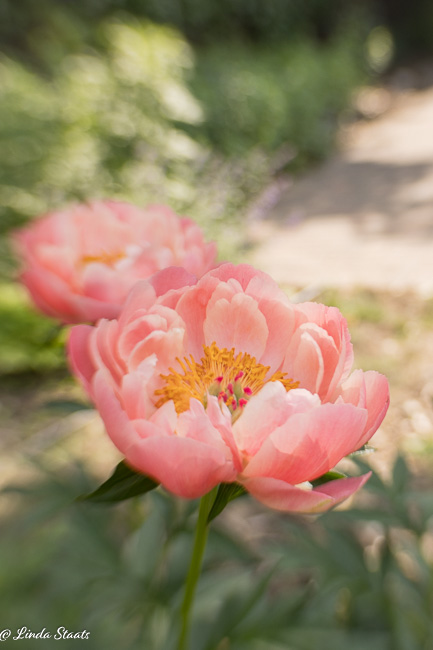
A softness to peony season

Spring seems to have been our shortest season this year. As soon as the snow went out of the landscape, green appeared. And yet now we’re already on the other side of spring into summer. We’ve had days of record-setting heat and humidity in the past week – a true reminder that June weather can bring just about anything.

The peonies in my garden burst into a riotous bloom a few weeks ago. There were shades of pink, red, magenta, maroon, white, and even a lovely coral. This is the one time of year I wish for no rain. May and June rains tend to be downpours, with raindrops falling hard through the sky and pelting any flower petals. This year we missed some of the heaviest rain, and the peony blossoms remained and came into full bloom.

I’m lucky to have some plants that are from my mother and father’s yard in Kansas. They’ve adjusted to our Minnesota weather, and I especially enjoy seeing those particular peonies come into bloom. My parents referred to peonies as “memorial flowers.” In Kansas they hoped the peonies would bloom right before Memorial Day so they could pick arm loads of them to place on the grave sites of family and relatives. I’ve since learned that tradition came after the Civil War when peonies were placed on the graves of fallen soldiers on what was then called Decoration Day. It was (and is still) a small gesture, but the remembrance and commitment is so much larger.

Awash in spring color

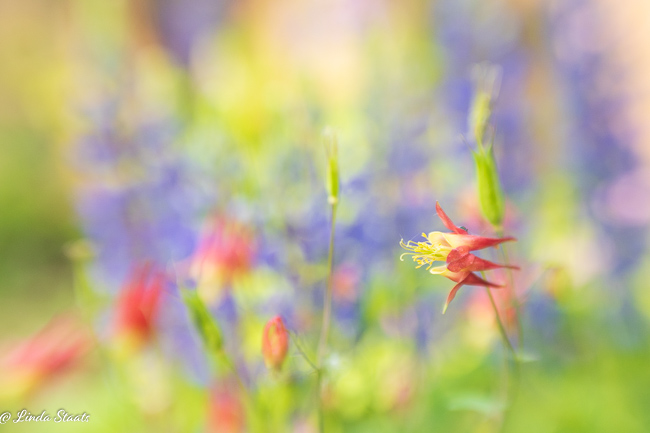
There is a lovely palette of colors in our landscape now. The rains and the sunshine have encouraged all the plants and flowers to burst into bloom and fullness. And with light winds the colors seem to dance before our eyes.

My garden is filled with this lovely orange and yellow columbine. The first plant was a transplant from my mother-in-law’s garden near their lake house. The columbine have multiplied and spread, and now stand tall and full in my garden. Behind is a stand of large lupines. These too were a gift from a dear friend who shared the lupine seeds. It took a couple of years for the plants to produce their lovely blue and purple blooms, but quickly they have spread and provide a lovely backdrop to the columbine.

A few days ago I awoke to an early, cool morning with the promise of a warm day ahead. Gradually the sun cleared the house and it’s brightness flooded the gardens. The birds chirped, a soft wind started to rustle, and I enjoyed a magical few hours surrounded by color and song in the garden.

A trip to Voyageurs National Park

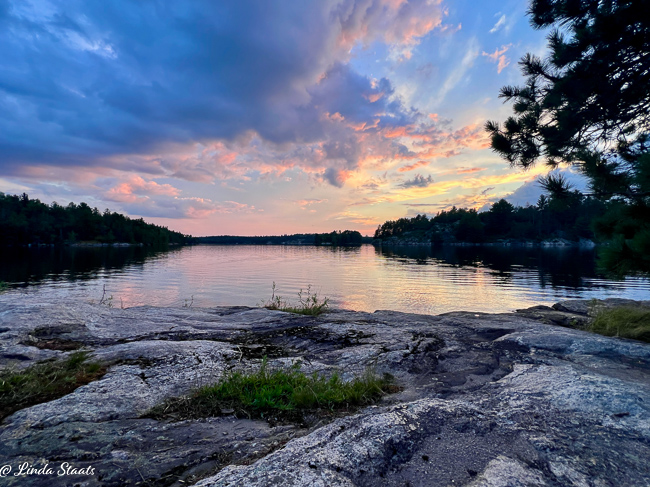
The land of big sky, big trees, big rocks, and big lakes – we’ve just returned from a camping trip to Voyageurs National Park in northern Minnesota. This park is unique as it’s a water-based park, and all campsites are boat-in. Lakes stretch 55 miles creating the northern boundary between the U.S. and Canada, and were traversed by the French-Canadian voyageurs during the late 1700’s and early 1800’s. Prior to that there were 18 American Indian tribes associated with these lands and waters.

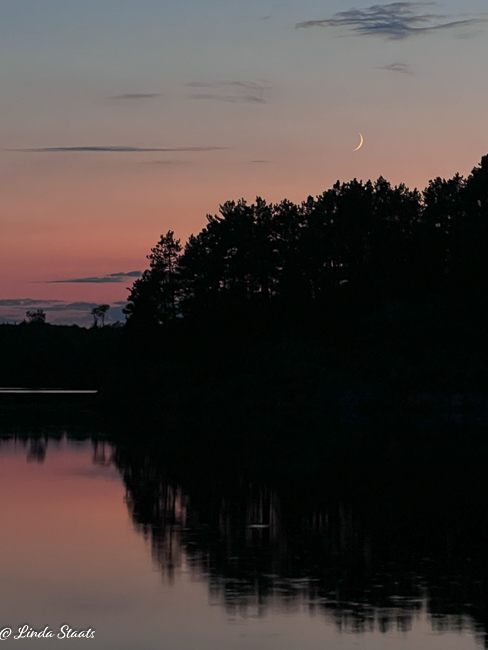
We departed from the Ash River Visitors Center with our 16-foot Lund fishing boat packed with camping gear and food. Reading lake navigational maps (a first for me!) we motored from Kabetogama Lake to Namakan Lake and found our campsite – a beautiful point on an island facing the southwest. The sunrises and sunsets are immense and envelop you from all sides. And here the rocks and trees go right down into the lake – part of the ruggedness of this area.

We explored an old logging camp in Hoist Bay that operated between 1913 and 1929. At the time, a railroad trestle extended out into the bay so timber logs could be floated to the trestle and loaded onto the railroad cars for inland transport to the mills. After the camp closed the area was turned into a resort, welcoming guests from 1939 to 1973. We wandered another island, amazed at the I. W. Stevens Pine Cove Resort which was opened in 1937 and operated for 22 years. Stevens purchased the island in 1932 and called it home until 1979. His house and cabins remain to give setting to his amazing story.

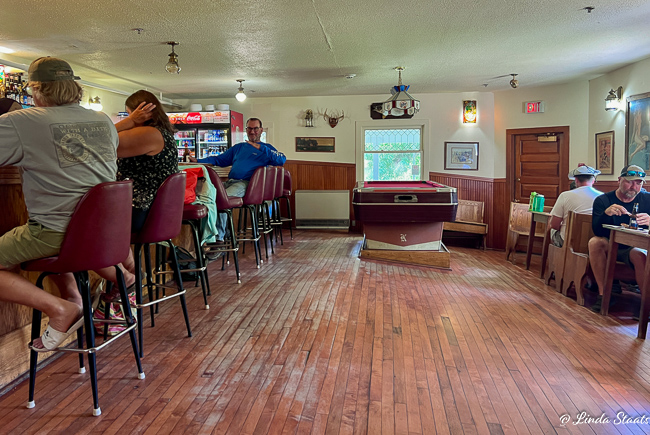
Another day we pointed our boat north and motored to the eastern tip of the roadless Kabetogama Peninsula to Kettle Falls. Here we marveled at the dam that was built in 1914, allowing enough water to move the timber industry’s logs to the mills and also supply water for paper production. We enjoyed lunch at the historic Kettle Falls Hotel, serving customers since l9l3. And no stop at the Kettle Falls Hotel is complete without a visit to the bar with its famous sloping floor. When the hotel was constructed the foundation was built on clay soil. Not the best for a long-term choice as it can sink over time, which it did. In the 1970’s when the National Park Service renovated the hotel they kept the bar room floor at its old slope, only raising the pool table so it would be level.

We returned with an appreciation for the history of this area and an admiration of the lives of the people who worked and lived here. And I have a great gratitude for the rugged beauty and wildness of this unique part of northern Minnesota, and the calmness that can be found here.