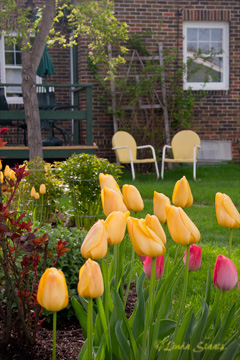
 With a delightful flourish spring is here! The past week has been a roller coaster of temperatures, from 39 degrees to 88 degrees, from sun to rain, from thunderstorms and peach-colored skies to clouds of gray. You name it, we’ve had it, including reports of snow flurries mixed in with the rain of yesterday. All this moisture with intervals of heat and sun have caused the trees to leaf out, tulips to bloom, lilacs to blossom. Such a great amount of activity packed into a short time-frame. When I lived in the Pacific Northwest spring lasted from February through June — probably the longest season of the year. Now that I’m in Minnesota our spring seems to be anywhere from two weeks to a month long. We linger in winter, jump through spring and straight into summer. Our spring days are presently filled with the sounds of birds chirping and lawn mowers being started. Neighbors are getting reacquainted after the cold winter. People are walking, running, biking – anything to be outside. Our backyard has become filled with color — green leaves and grass, yellow and red tulips, and the deep burgundy of the new peony shoots. It’s a joy to be outside to take it all in.
flowers
An amazing and beautiful Twin Cities garden
 Last year I had the most delightful opportunity to photograph a Twin Cities garden that was brimming with iris, hostas, peonies, and other flowers and plants. Patti and Lloyd Weber put all their love of gardening into their yard and garden beds, and the end result is a delightful respite of color and beauty. With numerous gardens throughout their yard it was a challenge as a photographer to capture each one. The “Parents and Grandparents Garden” has shrubs and flowers that have been passed down through the families, or ones they remember their relatives tending. The “Grandchildrens Garden” has round stepping-stones with each child’s footprint and name. The “Fairy Garden” is a delightful miniature garden with a sign reminding one to “Believe.” There’s even a “Hosta Hospital” where Lloyd cares for those plants needing a bit more TLC before going back into the main gardens. Everywhere I looked there was something to catch and delight my eye and cause me to slow down and capture the photograph. I visited the Webers many times last year and each time there was something new to see and photograph. It was a challenge to narrow down my submission images for the feature article that has just been published in the May/June issue of Northern Gardener Magazine. The iris on the cover shown here is “Orangutan Orange” and is one of over 100 different iris that grace their gardens. If you’re in the Minnesota area pick up a copy of the magazine and enjoy the beauty of the Webers’ gardens, their personalities, and their passions that are featured in the article. Northern Gardener Magazine is published by the Minnesota State Horticultural Society. For more information, please check their website at www.northerngardener.org.
Yellow of spring
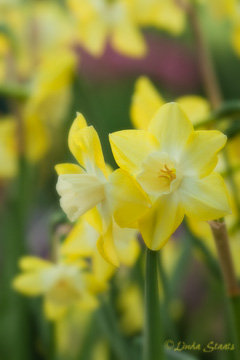 The one color that sums up everything about spring is yellow. It’s the color of sunshine, the color of warmth, and the color of daffodils. These bright flowers shine with color and promise and brighten any day. Although we don’t have daffodils blooming outside just yet, I was fortunate to find these lovely blooms at the McNeely Conservatory in Como Park. They speak to me of warmer temperatures, the end of winter, the hope of spring, and the promise of summer.
Something other than winter
 It is snowing now as I write this, and with the prospect of snow on four of the next five days, I just couldn’t bring myself to post another photo of winter, no matter how white, peaceful, calm, and beautiful it might be. So I went looking for something with the color of green – the color of spring and hope and warmth. These calla lilies seemed to fit the bill, even if they do include quite a bit of white! The gentle arches and curves of the flowers struck me as both delicate and beautiful. And in this image their colors take on a soft wash because of the shallow depth of field with the photograph. I know spring will yet arrive, even if winter has its tight-fisted grip on us for a bit longer.
Lessons learned from a sprained wrist
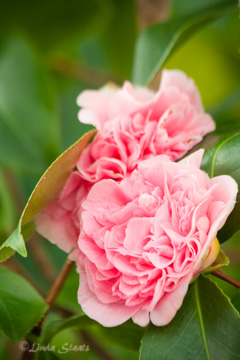 It’s now been two weeks since I slipped on our notorious Minnesota ice and badly sprained my right wrist. Much like the camellia in this photo, I am starting to emerge from this injury although I’m still seeking some protection as I do so. I realize though, that I’ve certainly learned some lessons from my injury: (1.) Appreciate all the things you take for granted. Until now I haven’t realized all the things, big and small, that I do with my hands. (2.) Trying to do things with a non-dominant hand is not as easy as one would think. OK….I tried to get my brain to talk to my left hand and tell it how to move and what to do, but of course the message wasn’t getting through completely. I have humbled myself many times as I fumbled trying to do simple tasks. (3.) Mindfulness is really important, and not second-nature. I have learned to pay more attention to what I am doing at a specific time. If I’m outside walking, I try to concentrate on my walking — one foot in front of the other. How easy it is to be distracted with thoughts of how cold it is, where I’m going, what I’m going to be doing there, what the roads are going to be like, what I’m having for lunch, etc, etc, etc. Live in the present!! (4.) When walking on ice or slippery surfaces, always carry things in your dominant hand. I read this tip the day after I injured my right wrist. If you have something in your dominant hand and you fall, you will most likely use your non-dominant hand to break your fall. OK, you just might injure it badly, but you will not be nearly as incapacitated as you would be with injuring your dominant hand. (5.) Everything takes longer when you have an injury, and patience is something to strive for. I haven’t been able to tie my boots, put a glove on my right hand, or turn the key in the car ignition without some assistance from either my left hand or from the willing two hands of a friend. My frustration would get the best of me at times. And photographing with a tripod and a dominant-hand injury forces me to slow down — look, observe, envision the shot, and only then do I spend the five minutes to mount the appropriate lens, place the polarizing filter, set the camera on the tripod, adjust the tripod legs, attach the cable release, focus, and then make the image. And just maybe, that’s not a bad thing.

